
 Category
Net Metering
Sell power back to the grid. How net metering works, how units are banked and credited on your bill, and whether it still pays after the latest rules.
4 videos
Net Metering Videos
 0:35Net Metering
Bidirectional Meter for Solar: How It Works and How You Get Paid
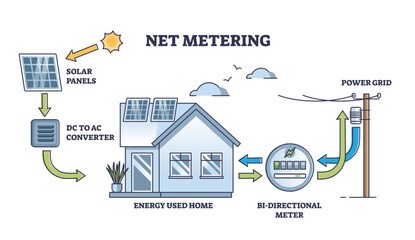
A bidirectional meter is the single device that decides how much your solar system actually earns you. It sits between your home and the grid, and it counts electricity moving in both directions: the power you pull in when your panels aren't producing enough, and the surplus you push back out when they're producing more than you need. Those two numbers are what your utility uses to build your bill or your export credits. This video walks through the essentials in under a minute. You'll see how import and export readings differ, what the two registers on your meter display actually mean, and why exported energy may not be credited at all if the correct meter isn't installed and approved first. We also cover the part most homeowners underestimate: the approvals. Getting a bidirectional meter fitted usually starts with an interconnection request to your utility, followed by a compliance inspection and then meter replacement and commissioning. In many regions this takes anywhere from two to twelve weeks, and the delays almost always come from paperwork rather than the installation itself. Finally, the money. Compensation isn't standardised anywhere in the world. Net metering credits your exports at the same retail rate you pay for power. Net billing credits them at a lower, wholesale-linked rate. Feed-in tariffs lock in a fixed rate for ten to twenty years. Gross metering sells everything to the grid and buys your usage back separately. Which one applies to you depends entirely on local policy — and that policy is shifting, with many regions moving away from traditional net metering toward net billing and hybrid models. The hardware behaves the same everywhere. The rules do not. Before you make any financial assumptions about your solar payback, check the framework in your own region. Solar Bazaar provides region-specific guidance on interconnection processes, export credits, meter requirements and tariff structures, and tracks policy changes so you can adapt if the rules shift after your system is installed.
0 views0:35 0:35Net Metering
Why Your Battery Beats Grid Export in 2026
Solar panels generate the most power in the middle of the day, but most homes use the most electricity in the evening. That gap is exactly where net metering rules and battery storage decide how much value you actually capture from your system. This short video walks through the full cycle in thirty seconds: rooftop generation during peak sun, storage in a home battery instead of low-value grid export, and evening consumption from energy you already produced. Across the Gulf and most global markets, export compensation is moving away from full retail net metering toward net billing and time-based pricing. In the UAE, for example, export rates sit around USD 0.05 to 0.10 per kWh while retail rates run from USD 0.08 to 0.30 per kWh. When that gap is wide, storing a kilowatt-hour is worth far more than exporting it. Without a battery, a typical home directly consumes only 30 to 50 percent of its solar output. Adding storage pushes self-consumption to 60 to 90 percent, depending on system size and load profile. In time-of-use markets, discharging during evening peak windows can lift returns by a further 10 to 30 percent. Watch this if you are planning a solar system, comparing hybrid inverters against AC-coupled retrofits, sizing a battery against your evening demand, or trying to understand whether your local export tariff justifies storage at all. For the full breakdown — export models by region, interconnection and metering requirements, cost and payback ranges, and a side-by-side regional comparison table — read our complete guide: Net Metering with Battery Storage: A Practical Guide.
1 view0:35 0:35Net Metering
Your Solar System Is Too Big (Here's Why)
Net metering rules have changed, and with them the entire logic of solar system sizing. In most markets today the electricity you export back to the grid earns considerably less than the electricity you buy — which means the familiar approach of sizing a system to match your annual bill can quietly erode the return you were counting on. This guide walks through what actually matters in 2026. It starts with the four export models you're likely to encounter and what separates them. Net metering credits your exports at close to retail value, though caps and time limits are increasingly common. Net billing lets you use your solar at retail value but pays for exports at wholesale or avoided cost, typically between $0.02 and $0.08 per kWh. Feed-in tariffs pay a fixed rate for exported energy, billed separately from what you consume, usually between $0.03 and $0.15. Gross metering exports everything you generate at a set rate that often sits below retail electricity prices. Which model applies to you is the single biggest factor in how large your system should be. The shift behind these changes is straightforward. Grids now carry far more solar than they did a decade ago, so midday electricity is abundant and cheap, while the cost of maintaining the network hasn't fallen. Policy has responded by rewarding self-consumption over export — and in many regions by layering time-of-use pricing on top, paying more during peak demand hours and less at noon when most rooftop systems are at full output. From there the guide covers the sizing fundamentals. You'll find the baseline formula — annual consumption in kWh divided by local solar yield — along with regional yield ranges spanning 900 to 1,200 kWh per kW per year in Northern Europe, 1,200 to 1,600 across the United States, China and Southern Europe, and 1,600 to 2,200 in the Middle East, Africa and Australia. Roof space, orientation, tilt and shading set the physical ceiling; policy caps often set a lower one. The more important question is how to adjust that baseline once export value enters the picture. Where near-retail credits and annual netting still apply, sizing to 100% of annual consumption remains sensible — summer surplus carries you through darker months. Where net billing or a low feed-in tariff applies, the same system sends a large share of its output out at a fraction of what you pay for imports, and payback stretches accordingly. In those markets the guide explains why sizing around daytime consumption produces a better result than sizing around the annual bill. Self-consumption gets its own treatment, because it has become the number that determines payback. Without storage it typically falls between 30% and 70% of generation. Every point above that baseline is worth full retail value rather than export value, and the guide covers the three levers that move it: shifting loads into daylight hours, smart controls and scheduling, and battery storage. In low-export markets, storage is often what makes a larger system viable at all, by moving afternoon surplus into the evening peak. A country-by-country comparison table sets out common 2026 patterns across the United States, Germany, India, Australia, Brazil and South Africa — export model, typical rate, residential size cap, netting period, whether oversizing is permitted, and the sizing strategy that suits each. Regional sections expand on North America, Europe, Asia, Africa and the Middle East, and Latin America. The guide also covers the technical and administrative constraints that catch people out late in a project. Residential grid connection limits commonly range from 3 to 15 kW. Some regions impose instantaneous export caps, which makes export-limiting inverters worth understanding — they can allow more panel capacity than export capacity where self-consumption is the goal. Multi-phase connections may require balanced output or enforce per-phase export limits that restrict usable capacity regardless of available roof space. On the paperwork side, expect an interconnection application, an export agreement, local permits, a system design and single-line diagram, and equipment certified to IEC or UL standards, with approval timelines running anywhere from 2 to 12 weeks. Finally, it looks at where policy is heading: declining, market-linked export payments, advanced meters and dynamic tariffs that change hourly, and the reality that rules can shift and often apply only to new applicants — which makes locking in terms early more valuable than it used to be. If you're deciding on a system size right now, start with two numbers: your total kWh over the last twelve months, and your utility's export model. Everything else follows from there.
2 views0:35 0:35Net Metering
Net Metering in Pakistan 2026: Full Process, Documents & Timeline
Net metering is the part of going solar that almost everyone underestimates. The panels go up in a few days, the inverter is wired in an afternoon, and then the application sits somewhere for two months because one datasheet was missing or the installer turned out not to be NEPRA-licensed. The hardware is the easy part. The paperwork is what decides when your system actually starts paying you back. None of the process is complicated in itself. It's a form, a site inspection, an agreement and a meter swap — four stages, each with a document attached to it. But the whole thing moves at the speed of the slowest missing paper, and every stage can send you back to the previous one if something doesn't match. A wiring detail that doesn't meet DISCO standards means the inspection fails. A missing inverter datasheet means the file sits unprocessed. An unlicensed installation may have to be partly redone before it can even be submitted. The financial side is worth understanding before you start, because it shapes how you size the system in the first place. Under current NEPRA rules your approved system size is capped near your sanctioned load, which means panels installed beyond that cap won't earn you export credit. People routinely oversize an array, get approved for less than they built, and discover the extra capacity is producing energy the meter won't credit. Checking your sanctioned load before you finalise your panel count costs you one phone call and can save a significant amount of money. Timelines vary by DISCO and by region, but four to eight weeks end to end is a realistic expectation in 2026 for a straightforward residential application. Cases that stretch past that are rarely stuck on approval itself — they're stuck waiting for a document, a correction, or a second inspection. Which is good news, because it means the timeline is largely within your control. This guide walks through the whole process in order: who's eligible and what the sanctioned load requirement actually means, the exact documents to prepare before you apply, what your DISCO checks during the site inspection, what the net-metering agreement commits you to, and how the bidirectional meter changes what appears on your bill. It also covers the specific mistakes that cause most delays, so you can avoid them before they cost you weeks.
5 views0:35


