SolarBazaar

Category

Net Metering

Sell power back to the grid. How net metering works, how units are banked and credited on your bill, and whether it still pays after the latest rules.

11 FAQs

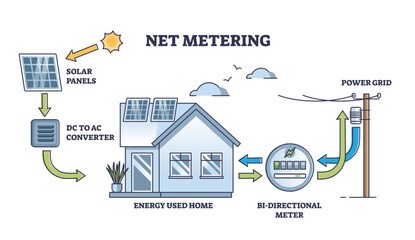
When your panels produce more than your home is using, the surplus flows back to the grid. Net metering credits you for that exported energy against the energy you import at night or on cloudy days.

A bidirectional (net) meter measures both directions — export and import — and your bill is based on the net difference. In effect, the grid acts like a battery: you 'bank' daytime surplus and draw it back later.

Rules and export rates vary by country and utility, so check your local net-metering policy. Where available, it significantly improves solar savings because none of your surplus is wasted.

This is general guidance — figures vary by location, tariff, equipment and installer. Always confirm details for your own home before deciding.

Open full answer →

Yes. Most grid-connected homes can send surplus solar to the grid and receive value for it, either as bill credit (net metering) or a per-unit payment (feed-in tariff), depending on your country and utility.

Under net metering, exports offset your imports one-for-one on the bill. Under a feed-in tariff, you're paid a set rate per exported unit — sometimes lower than the retail price you pay for imports.

Because export rates are often lower than what you pay to buy power, it usually pays to use your solar directly (or store it in a battery) rather than export it — but exporting surplus is still better than wasting it.

This is general guidance — figures vary by location, tariff, equipment and installer. Always confirm details for your own home before deciding.

Open full answer →

Yes, net metering generally applies to businesses as well as residential customers, though the specific terms, caps, and compensation rates can differ between the two, depending on your utility and region. Commercial net metering typically works the same basic way — exporting surplus solar energy earns bill credits that offset future electricity draw — but businesses often have larger systems, higher energy usage, and sometimes different rate structures like demand charges, which can affect how much value net metering actually provides compared to a typical home. Some utilities apply separate program caps or eligibility rules for commercial versus residential net metering, and larger commercial systems may face additional requirements around interconnection studies, metering equipment, or system size limits that residential customers don't usually encounter. Certain regions also offer commercial-specific alternatives, like feed-in tariffs or power purchase agreements (PPAs), which businesses may find more advantageous than standard net metering depending on their energy profile and financial goals. Because commercial net metering rules, caps, and rate structures vary considerably by utility and can be more complex than residential programs, it's worth getting a tailored assessment for your specific business rather than assuming the same terms as a home system — Solar Bazaar can help you evaluate net metering and other export options suited to your business's energy needs and usage patterns.

Open full answer →

A true-up bill is an annual (or sometimes periodic) statement that reconciles the total electricity you've drawn from the grid against the total solar credits you've earned over a billing cycle, typically spanning 12 months under net metering. Throughout the year, your monthly bills usually just show ongoing usage and banked credits without a final settlement, but the true-up bill totals everything up — if you generated more credits than you used, you may receive a payout (often at a lower rate than retail) or a rollover, and if you used more electricity than you offset with credits, you'll owe the difference at your utility's standard rate. It's calculated by comparing your cumulative kWh exported to the grid against your cumulative kWh drawn from the grid over the true-up period, factoring in any time-of-use rate differences, applicable credit expiration rules, and the specific compensation rate your utility applies to net surplus or deficit. Because true-up periods, calculation methods, and payout rates vary by utility and region, and because seasonal production swings can significantly affect your final balance, it's worth reviewing your utility's specific net metering agreement rather than assuming a standard calculation applies — Solar Bazaar can help you understand how your true-up bill will likely look based on your system size and local utility policy.

Open full answer →

Net metering approval timelines vary significantly by utility and region, but the process typically takes anywhere from a few weeks to a couple of months from application to final approval, depending on how many steps are involved. The general process usually includes submitting an interconnection application, having your utility review your system design, scheduling a physical inspection, and receiving final "permission to operate" (PTO) before your net metering agreement becomes active — each of these stages can add days or weeks depending on your utility's workload and local requirements. Some regions have streamlined, mostly digital approval processes that move faster, while others involve more manual review, multiple inspections, or backlogs during high-demand periods, which can push timelines out considerably longer than expected. Because approval speed depends so heavily on your specific utility's process, current application volume, and local permitting requirements, it's worth checking with your utility directly or your installer for a realistic timeline rather than assuming a fixed duration — Solar Bazaar can help you navigate the net metering application process and set realistic expectations based on your local utility.

Open full answer →

How long net metering credits last depends entirely on your utility company and local regulations, since there's no single standard — some utilities let credits roll over indefinitely, others reset them monthly or annually, and some cash out unused credits at a lower rate (often the wholesale rate rather than the retail rate you'd normally pay) at the end of a billing cycle or year. In many regions, credits roll over month to month within a billing year, letting you build up surplus in high-production months like summer and draw it down in lower-production months like winter, but any remaining balance at the end of the annual cycle may expire or get paid out at a reduced rate depending on local policy. Some utilities also cap how much credit you can accumulate or apply time-of-use rules, where credits earned during peak sun hours are valued differently than the electricity you draw during peak demand hours, which can affect how much value you actually retain. Because credit expiration, rollover rules, and payout rates vary so significantly by location and utility provider, it's important to check your specific net metering agreement rather than assuming credits work the same way everywhere — Solar Bazaar can help you understand your local net metering terms and design a system that makes the most of your credit cycle.

Open full answer →

Net metering itself doesn't "work" at night in the sense of generating anything new — your solar panels produce no electricity after dark, so there's nothing to export during that time. Instead, net metering works in reverse at night: you draw power from the grid to meet your household needs, and that usage gets offset against the surplus credits you built up from exporting extra solar energy during the day. This is essentially the whole point of net metering — it lets you rely on the grid as backup power at night while still getting financial credit for the excess electricity you generated earlier, so you're not paying full price for nighttime electricity as long as you have enough banked credits. Whether those credits carry over indefinitely, expire monthly, or get compensated at a lower rate than what you pay varies significantly by utility and region, which affects how much nighttime usage is actually offset. Because the value of net metering at night depends heavily on your specific utility's policy and billing cycle, it's worth understanding your local terms rather than assuming full offset — Solar Bazaar can help you understand your local net metering rules and design a system that maximizes your daytime export credits.

Open full answer →

Net metering is being reduced or ended in various regions for a mix of reasons, and the topic tends to involve competing perspectives depending on who you ask. Utility companies and some regulators argue that traditional net metering, which credits solar owners at the full retail electricity rate, shifts costs onto non-solar customers, since utilities still need to maintain the grid infrastructure that solar owners rely on for backup power, but solar owners pay less into that system through reduced bills. As more homes adopt solar, utilities argue this cost-shifting becomes a larger issue, pushing them to propose changes like net billing (lower export rates) or additional fixed charges for solar customers.

On the other side, solar industry advocates and many homeowners argue that reduced net metering undervalues the real benefits solar provides to the grid, such as reducing peak demand strain and delaying the need for costly infrastructure upgrades, and that these changes primarily protect utility profits rather than reflecting fair cost allocation. They also point out that reduced compensation can slow solar adoption, particularly for lower-income households who may already have paid off installation costs, and worry that changes made after a system is installed undermine long-term investment confidence.

The specific reasons and pace of these changes vary widely by region — some places are responding to genuinely rapid solar growth straining grid economics, while others face utility-driven policy lobbying with less clear grid-cost justification. Because policy changes and their underlying reasoning differ by state, country, or utility, it's worth checking your specific region's current and proposed net metering rules rather than assuming a single explanation applies everywhere—Solar Bazaar can help you understand your local net metering situation and plan your system around current and likely future policy changes.

Open full answer →

Net metering, in simple terms, is a billing arrangement where any extra electricity your solar panels produce and send back to the grid gets credited to your account, which you can then use to offset the electricity you draw from the grid at other times, like at night. Essentially, your electricity meter tracks the net difference between what you send out and what you pull in, so if you export more than you use over a billing period, you end up paying less on your bill, and if you use more than you export, you pay for the difference as usual. This means you don't need a battery to benefit from your daytime solar surplus, since the grid effectively acts as a giant "storage bank" that credits you for excess power and lets you draw it back later. Because net metering policies, credit rates, and rules vary significantly by country, utility company, and sometimes even region, it's worth checking your local regulations to understand exactly how much value you'll get from exporting surplus solar energy — Solar Bazaar can help you understand how net metering works in your area and design a system that makes the most of it.

Open full answer →

Yes, in many regions you can get paid for excess solar energy, though the amount and method depend heavily on your local utility policies and net metering or feed-in-tariff programs. Under net metering, excess energy typically earns you bill credits at or near the retail electricity rate, which you can use to offset future usage rather than receiving direct cash, while some regions offer a separate feed-in tariff that pays you a set rate per kWh for everything you export, sometimes as actual cash payments or account credits. In areas without full net metering, utilities may offer net billing instead, where exported energy is compensated at a lower wholesale rate rather than the retail rate, meaning you get some value but less than what you'd save by using that energy yourself. Whether unused credits or payments are issued monthly, annually, or carried forward also varies, and some regions cap how much compensation you can receive or require specific metering equipment to qualify. Because compensation structures differ so significantly by country, state, and even utility provider, it's worth checking your specific local program rather than assuming a standard payout rate — Solar Bazaar can help you understand what compensation options are available in your area and design a system optimized for maximum export value.

Open full answer →

No, net metering isn't strictly necessary if you have a battery, since the battery can store your daytime solar surplus for use at night instead of relying on the grid to bank and return that energy through credits. That said, most homes with both a battery and grid connection still benefit from net metering as a backup layer, since batteries have limited capacity and can only store so much — once your battery is full, any additional surplus either needs to go somewhere, and without net metering, that excess energy may simply be wasted rather than credited. For homes going fully off-grid, net metering becomes irrelevant entirely, since there's no grid connection to export to or draw from, meaning the battery and system sizing must be designed to cover all your energy needs independently. Because the right approach depends on whether you're grid-tied with battery backup or going fully off-grid, and how much storage capacity you actually have relative to your usage, it's worth evaluating your specific setup rather than assuming a battery replaces net metering entirely — Solar Bazaar can help you design a system that combines battery storage and grid export in the way that makes the most sense for your energy needs and goals.

Open full answer →